
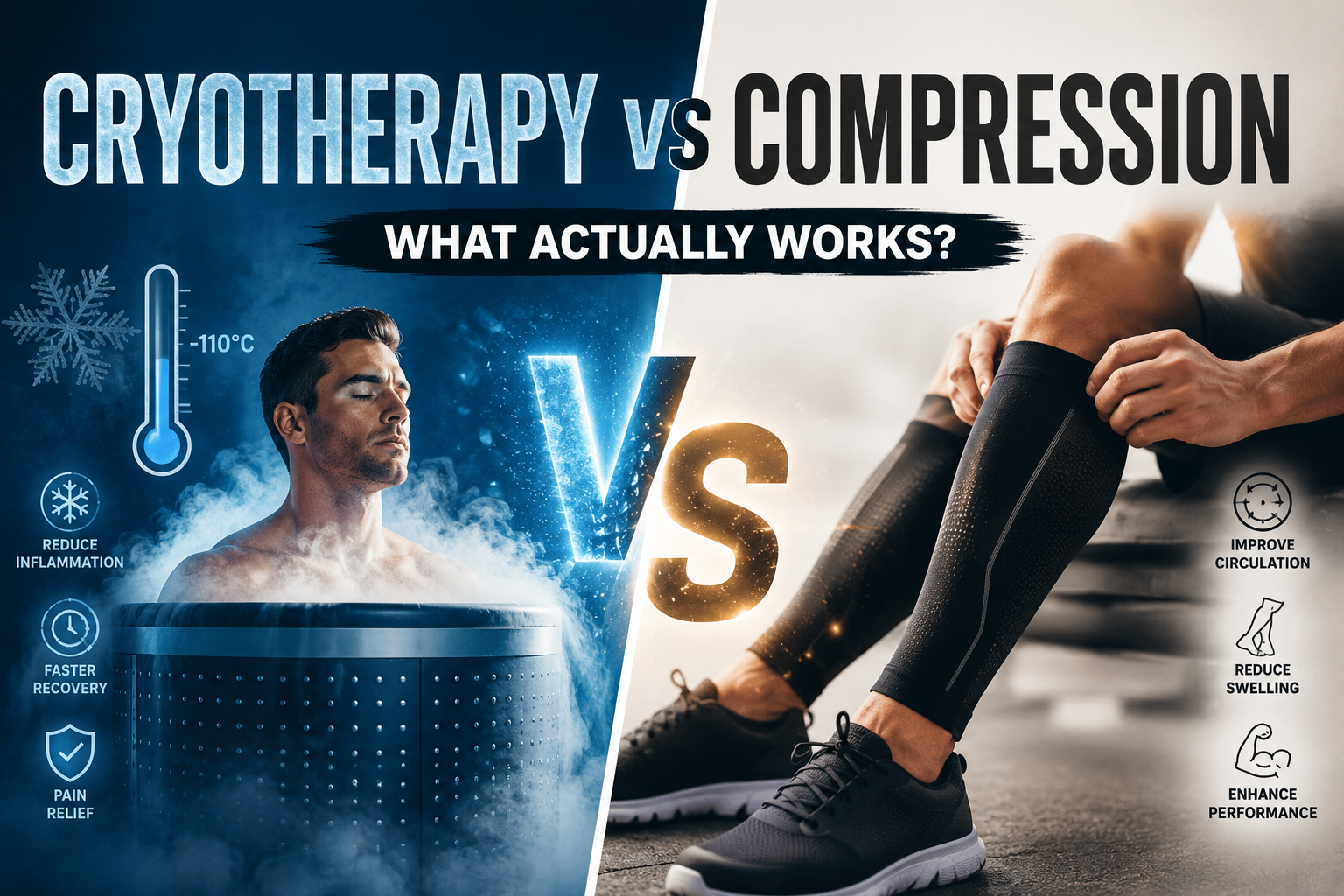
Cryotherapy vs Compression: What Actually Works?
Cold or compression? Two recovery methods dominate post-match protocols. One may be quietly undermining your training adaptations. Here is what the science actually says.

Marcus Vining
22 Apr 2026
Recovery is the hidden performance variable that separates elite teams from the rest. In the post-match landscape, two methods dominate the conversation: cold water immersion (cryotherapy) and compression garments. Both have vocal advocates. Both have genuine science behind them. And one of them may be quietly undermining your training adaptations if used at the wrong time.
This is not about which feels better in the ice bath or which looks more professional in the recovery suite. It is about understanding the physiology, interpreting the research without bias, and building a protocol that actually serves performance — not just the illusion of it.
The Biology of Post-Match Damage
Intense football creates mechanical muscle damage, metabolic byproduct accumulation, and localised inflammatory signalling. None of this is inherently bad. Inflammation is the first stage of repair. Delayed-onset muscle soreness (DOMS) peaks at 24 to 48 hours post-exercise and is largely a product of that repair cascade. The question is not whether to intervene, but when, and how aggressively.
Key Principle
Inflammation is not the enemy. Chronic inflammation is. Short-term inflammatory signalling after exercise is a necessary driver of adaptation. Suppressing it indiscriminately has a cost.
The Case For Cold
Cold water immersion (CWI) — typically 10 to 15°C for 10 to 15 minutes — induces peripheral vasoconstriction. Blood flow to the exercised limbs drops sharply. Metabolic activity slows. Swelling is reduced. When athletes emerge and tissues rewarm, a reactive hyperaemia flushes the area with fresh blood. This is the physiological rationale.
The evidence is real. Multiple meta-analyses confirm that CWI reduces perceived soreness and perceived fatigue at 24 and 48 hours post-exercise, compared to passive recovery. In high-frequency competition schedules — where the priority is readiness for the next match, not long-term adaptation — cold is a legitimate tool.
The Problem With Cold
Here is what the cold water advocates rarely lead with: CWI blunts training adaptation when used after resistance or strength-based sessions. A landmark study published in the Journal of Physiology found that athletes who used CWI after resistance training had significantly attenuated muscle hypertrophy and strength gains over twelve weeks compared to those who used active warm-down. The mechanism involves suppression of satellite cell activity and downstream mTOR signalling — the same molecular pathway that drives muscle growth and remodelling.
In short: cold is powerful but indiscriminate. It reduces inflammation across the board, including the adaptive inflammation you actually want. For a player in a heavy pre-season training block, routine cold immersion post-session may be slowing development rather than accelerating it.
The Science of Compression
Graduated compression garments — typically 15 to 30 mmHg — work through a different mechanism entirely. By applying consistent external pressure that increases distally (i.e., tighter at the ankle, decreasing toward the hip), they support venous return, reduce muscle oscillation during movement, and limit the extent of post-exercise oedema.
Critically, compression does not suppress the inflammatory cascade. It modulates the mechanical environment around the tissue without interfering with the molecular signals that drive recovery and adaptation. This distinction matters. Research from the International Journal of Sports Physiology and Performance shows that compression garments reduce DOMS and perceived fatigue comparably to CWI over 48-hour recovery windows, with the additional advantage of no detectable interference with training adaptations.
Head-To-Head: The Evidence Compared
When the research is examined directly, the picture becomes more nuanced than either camp acknowledges:
Building A Smarter Protocol
The answer is not to choose one tool and apply it universally. It is to match the modality to the training context. Here is a framework based on current evidence:
- Competition phase (2+ matches per week): CWI is appropriate. The priority is readiness for the next fixture, not long-term adaptation. Use 10 to 14 minutes at 12 to 14°C within 30 minutes post-match.
- Heavy training block (pre-season, fitness base): Avoid CWI post-strength or power sessions. Use compression garments (15–30 mmHg) worn for 12 to 24 hours post-session.
- Congested fixture schedule, tight turnaround: Compression garments worn overnight provide significant passive recovery benefit with zero pharmacological or adaptive cost.
- Combining both: Not always additive. If using both in the same recovery window, apply CWI first (acute phase), then compression garments for the extended recovery period.
What The Research Cannot Tell You
Individual response variance is significant. Some athletes report minimal soreness benefit from CWI and respond strongly to compression; others show the reverse. Training history, fibre-type distribution, and habituated recovery routines all modulate response. Systematic self-monitoring — rating perceived soreness, jump height, and grip strength before each session — provides more actionable data than blanket protocols.
The bottom line: cold is a powerful acute tool best reserved for competition contexts. Compression is versatile, adaptation-safe, and underused in training blocks. Neither is universally superior. The athlete who understands the distinction recovers better than the one following a fixed routine.